Why Your Creative Team Needs Review and Approval Software (And Why Email Is Slowly Killing Your Agency)
You've built an incredible creative team. They design stunning work. And then it all grinds to a halt because someone left feedback in a WhatsApp voice note. Let's fix that.
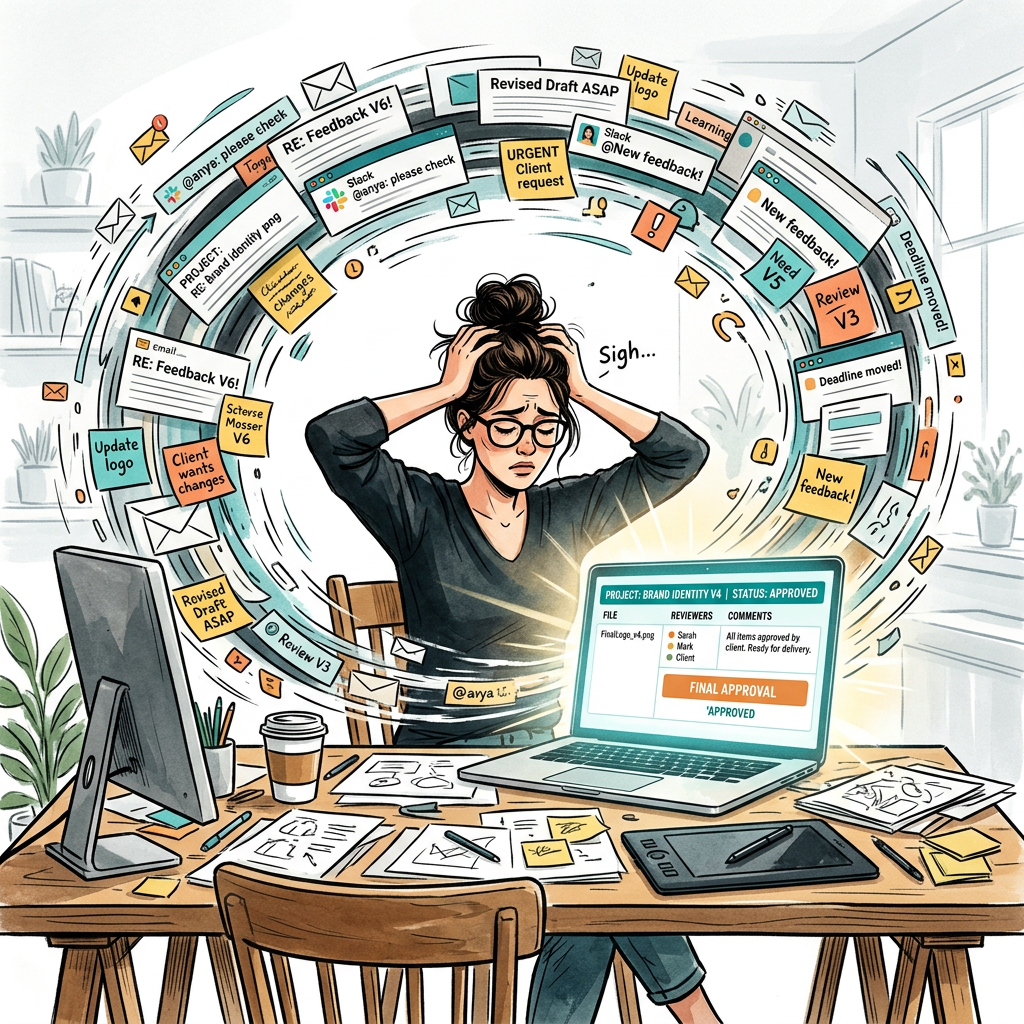
The creative feedback problem nobody talks about
Let's start with a confession: at some point, every creative agency has had a process that looked like this:
- Designer finishes a stunning brand concept.
- Account manager emails a PDF to the client.
- Client forwards it to their boss.
- Boss forwards it to legal.
- Legal replies to a completely different email thread.
- Account manager spends 45 minutes piecing feedback together from three email chains, a WhatsApp voice note, and a Post-it note someone photographed.
- Designer receives "consolidated" feedback that says: "Make it pop. Also, Gary in legal has concerns."
Sound familiar? You're not alone. This is the default workflow at an alarming number of creative agencies in 2026. And it's costing you real money.

What is review and approval software, anyway?
Before we go further, let's define the thing. Review and approval software is a platform where creative teams upload their work — videos, images, PDFs, websites, 3D models, audio — and collect structured, visual feedback from clients and stakeholders.
Instead of vague email notes, reviewers click directly on the file to leave pin-accurate comments. Instead of scattered threads, everything lives in one place. Instead of "which version?" confusion, there's automatic version control with side-by-side comparison.
And instead of chasing approvals across six different channels, there's a simple button: Approve or Request Changes.
It's the difference between running a professional creative operation and running a very expensive game of telephone.
The five stages of creative feedback grief
Every agency goes through these. See if you recognize yourself:
Stage 1: Denial
"Email works fine for us. We've always done it this way."
Sure. And people used to navigate by the stars. It worked — until GPS was invented. Email works for sending birthday wishes to your aunt. It does not work for collecting pixel-level feedback on a 30-second brand film from seven stakeholders.
Stage 2: Anger
"WHY IS THERE FEEDBACK IN THREE DIFFERENT SLACK CHANNELS?!"
This usually happens around the fourth revision round, when someone discovers the client's CEO left critical feedback in a LinkedIn DM to the founder.
Stage 3: Bargaining
"If I create a shared Google Sheet for feedback tracking, maybe this will work."
Narrator: It did not work. The spreadsheet was abandoned by Round 2, and everyone went back to email.
Stage 4: Depression
"We've been on revision 11. I've forgotten what the original brief was."
This is where burnout lives. Where scope creep flourishes. Where designers update their LinkedIn profiles.
Stage 5: Acceptance
"We need a proper review and approval tool."
Welcome. We've been expecting you.

The real cost of not having review and approval software
Let's talk numbers, because this isn't just about convenience — it's about money.
Time wasted on feedback logistics
The average creative project manager spends 5-8 hours per project consolidating feedback from different channels, clarifying vague comments, and chasing stakeholders for responses. For an agency running 20 projects at a time, that's a full-time employee dedicated to... organizing emails.
Extra revision rounds
Vague feedback creates extra revision rounds. Each round costs time, resources, and client patience. Teams using proper review and approval software report 40% fewer revision rounds because feedback is specific from the start.
Scope creep and unpaid work
When feedback isn't documented and approvals aren't formal, scope creep runs wild. "I never approved that" becomes a regular conversation. With review and approval software, every approval is timestamped, documented, and indisputable.
Client churn
Clients don't leave agencies because the designs are bad. They leave because the process is painful. A smooth, professional review experience keeps clients happy — and referring.
What good review and approval software looks like
Not all tools are created equal. Here's what the best review and approval software includes:
Pin-accurate feedback on every file type
Reviewers should be able to click on the exact spot they mean — not describe it in words. This works for images, videos (with timecode comments), PDFs, websites, 3D models, and audio files.

Multi-stage approval workflows
Creative work typically goes through multiple review stages: internal team → creative director → client → legal. Good review and approval software lets you set up sequential review groups that progress automatically.
Version control with visual comparison
Every upload creates a new version. Any two versions can be compared side by side. Comments are organized per version. No more "Final_V3_REAL_FINAL.pdf" nonsense.
Guest reviewer access
This is critical: your clients should NEVER need to create an account to leave feedback. If a review tool requires your client to sign up, you've already lost them. The best review and approval software lets anyone review via a simple shared link.
Integrations with your existing tools
Your review and approval software should play nicely with Slack (for notifications), Google Drive and Dropbox (for file sync), Monday.com or ClickUp (for project management), and your NLE software (for video production).
The transformation: before and after
Here's what the switch actually looks like:
Before review and approval software:
- 7+ revision rounds per project
- Feedback scattered across 4+ channels
- "Which version is this?" asked 3x per day
- Approvals tracked in... hope and memory
- Average project delivery: 3 weeks overdue
After review and approval software:
- 3-4 revision rounds per project
- All feedback in one visual workspace
- Automatic version tracking and comparison
- Timestamped formal approvals per reviewer
- Projects delivered on time (or even early)

"But we're a small team, do we really need this?"
Yes. Actually, small teams benefit the most. When you're a team of three, you can't afford to waste 8 hours per project on feedback logistics. You can't afford extra revision rounds. You can't afford scope creep eating into your margins.
Small teams that adopt review and approval software early build professional habits that scale. And most platforms (including Synks) offer free plans that are more than enough for small teams and freelancers.
The bottom line
Review and approval software isn't a luxury for big agencies. It's a fundamental tool for any creative team that wants to:
- Get clear, actionable feedback on the first try
- Reduce revision rounds and deliver faster
- Protect against scope creep with formal approvals
- Impress clients with a professional review experience
- Keep their creative team sane
Your team creates brilliant work. Don't let a broken feedback process be the thing that holds it back.
— The Synks Team
Ready to try Synks?
Start collecting visual feedback for free — no credit card required.
Get Started Free